Showing posts with label Civil Engineering Articles. Show all posts
Monday, January 26, 2015
Saturday, October 25, 2014
Story of a Civil Engineer
Civil Engineers are simple, yet innovative, hardworking, human loving problem solvers. They work for day and night to build luxury and felicity to protect you from hardships of nature. They sacrifice their own wishes and their own luxury just to let you feel safe in this unsafe world.
We civil Engineers do not negotiate with nature.
We do not compromise with hotsun, cold winter, heavy rain.
We work in deep valley, and thick forest.
We do land survey at nook and corner of the world.
We leave our families behind to build highway roads, rail tracks, cannels, dams and reservoirs.
We work at dangerous heights to build tall buildings
We are educated nomadic tribes, we move from place to place after completion of project.
We do not know Sundays and festivals we only know to work in forest.
We do not have entertainment means and metropolitans facilities.
We eat any kind of food available at the project site.
We do not have luxury accommodation, we stay in the temporary accommodation at project site.
We build prestigious monuments.
We know and learn all languages necessary to communicate with local labor.
We work with labor who are below the poverty line.
We understand the problem of poverty.
We understand how to eliminate poverty.
We can transform world into heaven
We are the future rulers of the world.
We only can make it possible.
So GOD likes and wants Civil Engineers
Here is a short story sent from a civil engineer working in the site as Site Engineer. You might get tears while reading it. But yet they all are stronger then the strength of steel they use in reinforcement.
Story of a Civil Engineer
We do not compromise with hotsun, cold winter, heavy rain.
We work in deep valley, and thick forest.
We do land survey at nook and corner of the world.
We leave our families behind to build highway roads, rail tracks, cannels, dams and reservoirs.
We work at dangerous heights to build tall buildings
We are educated nomadic tribes, we move from place to place after completion of project.
We do not know Sundays and festivals we only know to work in forest.
We do not have entertainment means and metropolitans facilities.
We eat any kind of food available at the project site.
We do not have luxury accommodation, we stay in the temporary accommodation at project site.
We build prestigious monuments.
We know and learn all languages necessary to communicate with local labor.
We work with labor who are below the poverty line.
We understand the problem of poverty.
We understand how to eliminate poverty.
We can transform world into heaven
We are the future rulers of the world.
We only can make it possible.
So GOD likes and wants Civil Engineers
Wednesday, October 22, 2014
Performing CPM Calculations and Scheduling on Primavera [TUTORIAL]
Primavera P6 has the capability that it can perform all the major project management tasks including Project Scheduling, Project Tracking, Drawing Bar Charts or Gantt charts, Drawing Network Diagrams, Establishing the Critical Path.
CPM stands for Critical Path Method, Critical Path by Definition is the longest path of the project Network Diagram having maximum duration of the activities. The critical path also has another definition in terms of float.
Float or Slack is the duration in which the activity can be delayed or adjusted without delaying the actual project duration. The critical path includes the activities that have zero project float.
In Construction projects Float is of two types total Float and Free float. Total Float is the maximum time for which an activity can be delayed without delaying the project.
Whereas free float is maximum time for which an activity can be delayed without delaying the start of proceeding activity.
In any construction project the planning engineer first formulate WBS ( work breakdown structure) that divides the whole project in set of various works like electrical works, construction works, finishing works, plumbing works etc.
In WBS the planning engineer than assigns the activities to the corresponding WBS along with the durations estimated on the basis of past experience or some templates from the organization.
The thing that is very important in the planning stage of the project is to create links between various activities. The link or relation between activities is of two types:-
a) Predecessor
b) Successor
In primavera Successor activities are those that are to be performed immediately in succession of concerned activity. Predecessor activities are those that must be started or completed with the completion or startup of concerned activity.
Primavera relates activities in 4 different ways;
SF – Start to Finish
SS – Start to start
FS – Finish to start
FF – Finish to finish
In the planning stages we have to determine the most appropriate linkage between various activities so as to create the network diagram and determine the critical path.
In CPM calculations we determine the following;
a) Network diagram
b) Early Start
c) Early Finish
d) Late Start
e) Late Finish
f) Critical Path
g) Total Float
h) Free Float
Example;
Let’s do a simple example on Primavera to perform network diagram;
Step # 1;
Create a new project for that
File -> New Project or Press Ctrl + N
Click next in the Wizard; or select appropriate Enterprise Project Structure
Enter the Project ID as “Ex1” and Project Title as “Example 1” as shown;
Click Finish to terminate the Project.
In the Projects Directory Open the Project you have just created as shown;
Then go to activities by clicking the activity directory button as shown;
Right click anywhere in the activities panel and click ADD or Press insert button
In the activity Name enter A and in activity Orignal Duration Enter 3 as shown;
Repeat the above step and enter all the activities as shown in the table like this;
The Next step is to insert the activities relation as given in the table
For that Click the activity for which you want to give the processor or successor in our example we will give the successor and will check the predecessors accordingly.
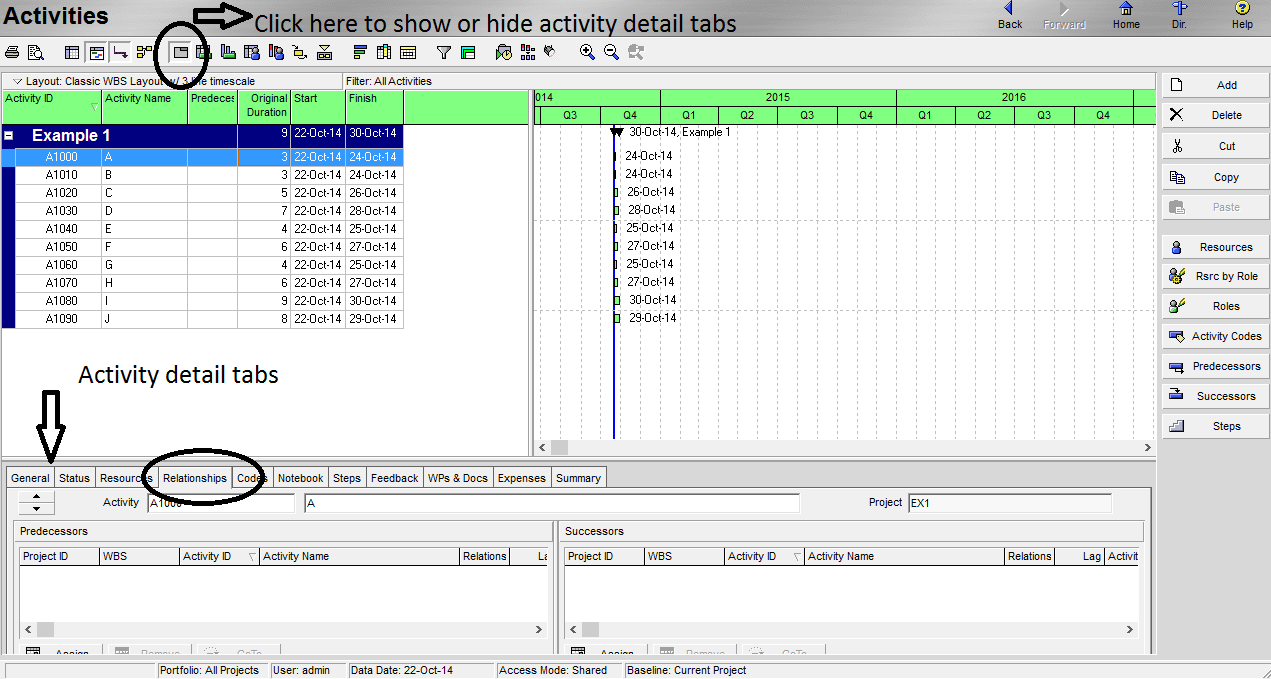
After clicking the activity go to the activity detail tabs go to relationships as shown;
Click the assign Successor command button on the command bar as shown;
Note; you can view the command bar button text from view->toolbars-> Command bar button text
From the assign successors dialog box select B C and D by Pressing Ctrl and using left mouse click;
After selecting the successors click the assign successor button as shown;
You will see in the activity details tabs relationships that B, C and D are added as successors.
Repeat the above procedure and assign the successor as shown in the above table.
After assigning successors you will see the predecessors already assigned as shown;
In the Next Step we will adjust the Activity layout columns to show the columns we needed for the CPM calculations;
For that right click in the activity panel and click columns as shown;
In the Columns dialog box;
By using ctrl + Click select the un-necessary columns as shown and click the remove from list button as shown;
In the available column options go to Dates-> select Early Start Early Finish Late Start Late Finish and click add to the list button as shown;
Similarly in the Duration category add Free float andTotal Float to the available list and Click Ok.
Your activity panel now should look like similar to the one show;
Now you are ready to complete the schedule process and do the CPM calculations;
For that go to Tools-> Schedule or Press F9 as shown;
Without changing anything in the schedule dialog box click the schedule button as shown;
After scheduling you will see the Gantt chart along with the CPM scheduling calculations as shown in the figure;
To see the network diagram and the critical path just click the Activty Network Button as shown; and then you will see the network diagram, the activities linked with red arrowheads dictate the critical path.
You can check the calculations and the network diagram using by-hand calculation and using CPM calculations by hand solved as follows;
CPM stands for Critical Path Method, Critical Path by Definition is the longest path of the project Network Diagram having maximum duration of the activities. The critical path also has another definition in terms of float.
Float or Slack is the duration in which the activity can be delayed or adjusted without delaying the actual project duration. The critical path includes the activities that have zero project float.
In Construction projects Float is of two types total Float and Free float. Total Float is the maximum time for which an activity can be delayed without delaying the project.
Whereas free float is maximum time for which an activity can be delayed without delaying the start of proceeding activity.
In any construction project the planning engineer first formulate WBS ( work breakdown structure) that divides the whole project in set of various works like electrical works, construction works, finishing works, plumbing works etc.
In WBS the planning engineer than assigns the activities to the corresponding WBS along with the durations estimated on the basis of past experience or some templates from the organization.
The thing that is very important in the planning stage of the project is to create links between various activities. The link or relation between activities is of two types:-
a) Predecessor
b) Successor
In primavera Successor activities are those that are to be performed immediately in succession of concerned activity. Predecessor activities are those that must be started or completed with the completion or startup of concerned activity.
Primavera relates activities in 4 different ways;
SF – Start to Finish
SS – Start to start
FS – Finish to start
FF – Finish to finish
In the planning stages we have to determine the most appropriate linkage between various activities so as to create the network diagram and determine the critical path.
In CPM calculations we determine the following;
a) Network diagram
b) Early Start
c) Early Finish
d) Late Start
e) Late Finish
f) Critical Path
g) Total Float
h) Free Float
Example;
Let’s do a simple example on Primavera to perform network diagram;
| Activity Name | Activity Duration | Successors |
| A | 3 | B,C,D |
| B | 3 | E,F,G |
| C | 5 | G |
| D | 7 | J,I |
| E | 4 | J,H |
| F | 6 | J |
| G | 4 | J |
| H | 6 | - |
| I | 9 | - |
| J | 8 | - |
Step # 1;
Create a new project for that
File -> New Project or Press Ctrl + N
![]() |
| Creating a New Project (Click to Enlarge) |
Enter the Project ID as “Ex1” and Project Title as “Example 1” as shown;
![]() |
| Give Name to the Project |
In the Projects Directory Open the Project you have just created as shown;
Then go to activities by clicking the activity directory button as shown;
![]() |
| Adding Activites (Click to Enlarge) |
![]() |
| Click Add (Click to Enlarge) |
![]() |
| Give Duration and name to activites |
![]() |
| All the activities (Click to Enlarge) |
For that Click the activity for which you want to give the processor or successor in our example we will give the successor and will check the predecessors accordingly.
![]() |
| Adding relations (Click to Enlarge) |
After clicking the activity go to the activity detail tabs go to relationships as shown;
Click the assign Successor command button on the command bar as shown;
Note; you can view the command bar button text from view->toolbars-> Command bar button text
![]() |
| Successors (Click to Enlarge) |
From the assign successors dialog box select B C and D by Pressing Ctrl and using left mouse click;
![]() |
| Assigning Successors (Click to Enlarge) |
After selecting the successors click the assign successor button as shown;
You will see in the activity details tabs relationships that B, C and D are added as successors.
![]() |
| Assigned accessors (Click to Enlarge) |
Repeat the above procedure and assign the successor as shown in the above table.
![]() |
| Check Predecessors |
After assigning successors you will see the predecessors already assigned as shown;
In the Next Step we will adjust the Activity layout columns to show the columns we needed for the CPM calculations;
For that right click in the activity panel and click columns as shown;
![]() |
| Adding Columns |
In the Columns dialog box;
By using ctrl + Click select the un-necessary columns as shown and click the remove from list button as shown;
![]() |
| Delet old ones (Click to Enlarge) |
In the available column options go to Dates-> select Early Start Early Finish Late Start Late Finish and click add to the list button as shown;
![]() |
| Adding New ones |
Similarly in the Duration category add Free float andTotal Float to the available list and Click Ok.
Your activity panel now should look like similar to the one show;
![]() |
| CPM Layout of activity table view |
Now you are ready to complete the schedule process and do the CPM calculations;
For that go to Tools-> Schedule or Press F9 as shown;
Without changing anything in the schedule dialog box click the schedule button as shown;
![]() |
| Scheduling(Click to Enlarge) |
After scheduling you will see the Gantt chart along with the CPM scheduling calculations as shown in the figure;
![]() |
| Scheduling Dialog Box |
To see the network diagram and the critical path just click the Activty Network Button as shown; and then you will see the network diagram, the activities linked with red arrowheads dictate the critical path.
![]() |
| CPM Scheduling |
![]() |
| CPM Network Diagram |
You can check the calculations and the network diagram using by-hand calculation and using CPM calculations by hand solved as follows;
![]() |
| Recheck the Work done (Click to Enlarge) |
From Editors Desk
So my friend this is a very basic tutorial for each and every beginner who doesn't know what is primavera or what actually primavera is capable off. The course of Project Management is learned in Civil Engineering in which CPM and PERT calculations are performed by hand, here in This tutorial we have used Primavera to just let you know how easy it is to perform all those scheduling and CPM calculations in just few clicks. I hope you would like this tutorial. Don't Forget to share it with your friends on fb and twitter. If you have any question Comment below
Tuesday, October 21, 2014
Highway Materials Types and Characteristics
Highway construction can be characterized by large right-of-way having length of considerable amount. Due to this Highway construction constitutes materials that are needed in large quantum. Depending upon the type of highway pavement, flexible or rigid the material required for highway construction is decided. This post contains general information regarding the Types of materials used in a highway construction and their characteristics are also discussed.
These items of major importance which are used in normal highway construction
are:
1. Bituminous Materials
2. Soil
3. Aggregates
4. Portland Cement Concrete
5. Admixtures
6. Pavement Marking Materials
7. Structural Steel
• Its use ranges from binders for the highest type pavements of complex engineering designs for the ultimate traffic, to direct spray
applications.
• To protect an existing pavement or to provide a low-cost, all-weather road for a minimum of traffic.
• Asphalt materials, as used, range in consistency from semisolid to liquid products, which are processed and blended to conform to specification requirements for various types and grades.
• Asphalt is normally a residue product from the distillation of crude oil and, as refined, is a heavy, viscous material that is semisolid at normal atmospheric temperatures.
• By controlled processing or blending desired viscosity and hardness
characteristics can be produced.
• This product is called asphalt cement and is also known as paving grade or penetration grade asphalt.
• Bituminous Materials, of the Highway Materials Manual contains the test procedures, sampling requirements, and test equipments.
• Necessary to characterize and control, within specification requirements, asphalt cements, cutback asphalts, emulsified asphalts, and asphalt -aggregate mixtures.
• Emulsion, is made from asphalt cement.
• It is tiny particles of asphalt cement mixed with water and an emulsifying agent — usually a detergent.
• Emulsions are called liquid asphalts because, unlike asphalt cements, they are liquid at normal air temperatures and therefore do not require heat to liquefy.
• To produce emulsions, hot asphalt cement and water containing the emulsifying agent are pumped at high pressure through a colloid mill.
• The emulsifying agent coats the asphalt particles and puts an electric charge on their surfaces.
• This charge causes the asphalt droplets to repel one another so they don’t combine.
• These charges are used to categorize emulsions as cationic (positive charge) or anionic (negative charge).
• Charges are important because they affect the compatibility of emulsion with mineral aggregates.
• An anionic emulsion should be used with limestone aggregate that usually bears a positive surface charge.
• A cationic emulsion should be used with sandstone because these aggregates usually bear a negative surface charge.
• After an emulsion is mixed with aggregates it sets or breaks.
• The asphalt droplets react with the aggregate and combine, squeezing out the water.
• The water then evaporates, leaving the asphalt droplets to set and produce a continuous film on the aggregates.
1. An asphalt binder less soft in hot weather and less brittle in cold weather.
2. Improved asphalt binder adhesion and strength for increased cover aggregate/chip retention.
3. The ability for earlier sweeping to remove excess chips.
4. The surface treatment of roads, streets and highways with higher traffic volumes and
speeds.
5. Allows for the use of larger size chips.
• Not only does soil form the foundation, or supporting surface for buildings, bridges, roadways and culverts, but it is the most common constituent, in the form of aggregate, in the works themselves.
• Soils are the most basic abundant material in highway engineering and as such, are well characterized by the expression "common as dirt."
• The steps taken to prepare foundations manipulate and transport soils and prepare them for use as aggregates accounts for well over 70 percent of the total cost of construction for a normal highway project.
• It is easy to see then why knowledgeable consideration of every aspect of soils is very important to successful highway engineering.
• The strength properties of a layer are a function of both the quality and the proportions of ingredients.
• Aggregates are hard, durable, mineral materials obtained by mining or quarrying operations of deposits of sand, gravel, talus or ledges, and may be defined as "granular material of mineral composition.
• Used either in combination with a binding medium to form bituminous concrete, Portland cement concrete, mortar, plaster, etc., or alone as in road bases, railroad
ballast, filter beds, etc."
• It is formed when the cement and water (paste) combine chemically and binds the entire mixture into a rock-like mass.
• It may be thought of as a two component material; paste and aggregate.
• The paste is comprised of cement, water, and entrained air.
• The aggregate portion is generally composed of sand and gravel and comprises 70 to 80 percent of the volume of the concrete.
• Aggregates both fine and course, should be selected for their quality, strength, durability and resistance to environmental affects.
• They should be smoothly graded. The quality of the concrete depends also on the quality of the paste.
• In properly made concrete each particle of aggregate is completely coated with paste and all of the space between particles is filled with paste.
• Other additives gaining in usage are known as water reducing admixtures and set retarding admixtures.
• Water reducing additive is intended to impart more workability into a plastic concrete with less water, thereby increasing its strength through a reduced water/cement ratio.
• Set retarding additive is intended to slow the setting characteristics of the mix and thereby allowing more time for placing and finishing.
• However, these additives are of diverse chemical compositions and can produce adverse reactions when used in a mix, either between the additives themselves when combined in a mix or with the cement, aggregates or water making up the
mix.
• Any time an additive is proposed for use in a mix, trial mixes should be made with the additives to evaluate their effectiveness and to check for any adverse reactions.
• Pavement markings convey important information to drivers without diverting their attention from the road.
• In some cases they supplement regulations or warnings given by other devices.
• In other cases they are used alone and produce results that cannot be obtained
by any other device.
• Many materials can be used for pavement marking.
• The choice depends on cost, durability, reflectivity, pavement surface, and drying time.
visibility, and good reflectivity.
new construction, or overlaid. It has excellent visibility
and reflectivity and lasts 7-8 years, but is higher
cost. Wet reflective tape has excellent wet night reflectivity
with about a 4-year life. Cost is medium
and durability is poor
![]() |
| Highway Materials Types and Characteristics |
are:
1. Bituminous Materials
2. Soil
3. Aggregates
4. Portland Cement Concrete
5. Admixtures
6. Pavement Marking Materials
7. Structural Steel
Bituminous Materials
• Bituminous material, or bitumen in the form of asphalt, is one of the major highway construction materials used.• Its use ranges from binders for the highest type pavements of complex engineering designs for the ultimate traffic, to direct spray
applications.
• To protect an existing pavement or to provide a low-cost, all-weather road for a minimum of traffic.
• Asphalt materials, as used, range in consistency from semisolid to liquid products, which are processed and blended to conform to specification requirements for various types and grades.
• Asphalt is normally a residue product from the distillation of crude oil and, as refined, is a heavy, viscous material that is semisolid at normal atmospheric temperatures.
• By controlled processing or blending desired viscosity and hardness
characteristics can be produced.
• This product is called asphalt cement and is also known as paving grade or penetration grade asphalt.
• Bituminous Materials, of the Highway Materials Manual contains the test procedures, sampling requirements, and test equipments.
• Necessary to characterize and control, within specification requirements, asphalt cements, cutback asphalts, emulsified asphalts, and asphalt -aggregate mixtures.
Emulsified asphalt,
• It is tiny particles of asphalt cement mixed with water and an emulsifying agent — usually a detergent.
• Emulsions are called liquid asphalts because, unlike asphalt cements, they are liquid at normal air temperatures and therefore do not require heat to liquefy.
• To produce emulsions, hot asphalt cement and water containing the emulsifying agent are pumped at high pressure through a colloid mill.
• The emulsifying agent coats the asphalt particles and puts an electric charge on their surfaces.
• This charge causes the asphalt droplets to repel one another so they don’t combine.
• These charges are used to categorize emulsions as cationic (positive charge) or anionic (negative charge).
• Charges are important because they affect the compatibility of emulsion with mineral aggregates.
• An anionic emulsion should be used with limestone aggregate that usually bears a positive surface charge.
• A cationic emulsion should be used with sandstone because these aggregates usually bear a negative surface charge.
• After an emulsion is mixed with aggregates it sets or breaks.
• The asphalt droplets react with the aggregate and combine, squeezing out the water.
• The water then evaporates, leaving the asphalt droplets to set and produce a continuous film on the aggregates.
Advantages:
The following advantages have been reported for chip seals when using:1. An asphalt binder less soft in hot weather and less brittle in cold weather.
2. Improved asphalt binder adhesion and strength for increased cover aggregate/chip retention.
3. The ability for earlier sweeping to remove excess chips.
4. The surface treatment of roads, streets and highways with higher traffic volumes and
speeds.
5. Allows for the use of larger size chips.
Soils
• Major works of man since the beginning of time have depended on the use of soils.• Not only does soil form the foundation, or supporting surface for buildings, bridges, roadways and culverts, but it is the most common constituent, in the form of aggregate, in the works themselves.
• Soils are the most basic abundant material in highway engineering and as such, are well characterized by the expression "common as dirt."
• The steps taken to prepare foundations manipulate and transport soils and prepare them for use as aggregates accounts for well over 70 percent of the total cost of construction for a normal highway project.
• It is easy to see then why knowledgeable consideration of every aspect of soils is very important to successful highway engineering.
Aggregates
• The surface, base, and sub base of pavements consist of aggregates or a mixture of aggregates with cement and water (Portland cement concrete) or a bituminous material (bituminous concrete).• The strength properties of a layer are a function of both the quality and the proportions of ingredients.
• Aggregates are hard, durable, mineral materials obtained by mining or quarrying operations of deposits of sand, gravel, talus or ledges, and may be defined as "granular material of mineral composition.
• Used either in combination with a binding medium to form bituminous concrete, Portland cement concrete, mortar, plaster, etc., or alone as in road bases, railroad
ballast, filter beds, etc."
Portland Cement Concrete
• Portland cement concrete is a mixture of portland cement, water, air, sand and gravel or crushed stone.• It is formed when the cement and water (paste) combine chemically and binds the entire mixture into a rock-like mass.
• It may be thought of as a two component material; paste and aggregate.
• The paste is comprised of cement, water, and entrained air.
• The aggregate portion is generally composed of sand and gravel and comprises 70 to 80 percent of the volume of the concrete.
• Aggregates both fine and course, should be selected for their quality, strength, durability and resistance to environmental affects.
• They should be smoothly graded. The quality of the concrete depends also on the quality of the paste.
• In properly made concrete each particle of aggregate is completely coated with paste and all of the space between particles is filled with paste.
Admixtures
• In recent years there have come into use a number of additives developed to improve various characteristics of concrete in both the plastic and hardened states.• Other additives gaining in usage are known as water reducing admixtures and set retarding admixtures.
• Water reducing additive is intended to impart more workability into a plastic concrete with less water, thereby increasing its strength through a reduced water/cement ratio.
• Set retarding additive is intended to slow the setting characteristics of the mix and thereby allowing more time for placing and finishing.
• However, these additives are of diverse chemical compositions and can produce adverse reactions when used in a mix, either between the additives themselves when combined in a mix or with the cement, aggregates or water making up the
mix.
• Any time an additive is proposed for use in a mix, trial mixes should be made with the additives to evaluate their effectiveness and to check for any adverse reactions.
Pavement Marking Materials
• Pavement markings have important functions in providing guidance and information to drivers.• Pavement markings convey important information to drivers without diverting their attention from the road.
• In some cases they supplement regulations or warnings given by other devices.
• In other cases they are used alone and produce results that cannot be obtained
by any other device.
• Many materials can be used for pavement marking.
• The choice depends on cost, durability, reflectivity, pavement surface, and drying time.
Paint
Water-based paint, applied either cold or hot, is the most commonly used pavement marking. It is low cost with a short drying time, but its visibility on wet nights is just moderate.Thermoplastics
These pavement-marking materials are made of thermoplastic heated to about 400° F and spread onto the pavement surface. Glass beads to increase reflections can be spread on top, mixed in, or both. Thermoplastics have a long service life, goodvisibility, and good reflectivity.
Epoxy
Also applied as a liquid with special equipment, epoxy has good visibility and reflectivity, and cost is moderate. Markings remains 3 to 4 years.Tapes
Pre-formed tape can be either inlaid as part ofnew construction, or overlaid. It has excellent visibility
and reflectivity and lasts 7-8 years, but is higher
cost. Wet reflective tape has excellent wet night reflectivity
with about a 4-year life. Cost is medium
and durability is poor
Friday, October 17, 2014
Applications of Fluid Mechanics in Practical Life Engineering Projects
Fluid mechanics
Fluid mechanics is the branch of physics that studies fluids and forces on them. Fluid is defined as any gas or liquid that adapts shape of its container. Fluid mechanics has following branches; fluid statics, the study of the behavior of stationary fluids; fluid kinematics, the study of fluids in motion; and fluid dynamics, the study of the effect of forces on fluid motion.
Applications of Fluid Mechanics in Practical Life Engineering Projects:
1. Refrigerators and Air Conditioners: The fluids used in refrigerators and air-conditioners are known as refrigerants. The refrigerant absorbs the heat from evaporator, which is at a low temperature, and distributes that heat to the atmosphere, which is at a high temperature. In air conditioners, the refrigerant absorbs room heat and throws it in to the atmosphere keeping the room cool. The whole process of refrigerators and air-conditioners depends on the use of a refrigerant.
2. Airflight: One of the most ordinary applications of Bernoulli's principle is airflight. The airplane wing is curved from the top and flat from the bottom. While moving in sky, the air on the bottom moves slowly and builds more pressure on the bottom, and allows for the air on the top to move faster, which builds less pressure. This creates lift, which allows planes to fly. An airplane is also acted upon by a pull of gravity in which faces lift, drag and thrust. Thrust is the force that allows the airplane to move forward while drag is air resistance that opposes the thrust force.
3. Sailing: The principle of sail is same as an airplane wing. Sail boats have two parts: a sail which points north and a keel which points on the opposite direction. When the wind movements are on one side it fills the sail while the air flowing on the other side is moving faster and cannot push as hard and thus the sail receives a force which is perpendicular to the direction of the wind. Usually this would not push the boat against the wind but the keel of the boat again resists much of the horizontal movement so that the boat only moves in forward direction, providing that the combined forces that are pushing the boat perpendicular to the wind are greater than the force of the wind pushing the entire boat and sails backwards.
4. Pump & motor: Pump is a device which is made for moving fluid, and it is done by developing a pressure difference, causing the fluid to move from an area of high pressure to low pressure. Its procedure is based on both Pascal's and Bernoulli's principles.The hydraulic motor is the rotary complement of the hydraulic cylinder. Conceptually, a hydraulic motor should be compatible with the hydraulic pump, due to the fact it performs the opposite function. However, most hydraulic pumps cannot be functioned as hydraulic motors because they cannot be back driven. The hydraulic motor is typically designed for the working pressure at both sides of the motor.
5. Hydraulic brake system: Hydraulic brakes system is a method to stop an object by applying energy. Hydraulic brakes work when you push the brake pedal, it pushes the small piston. The piston transfers pressure on the brake fluid, which press the brake pads on the large pistons. The brake pads come in contact with the brake drum and slow the car, ultimately stopping it.
6. Jack: Jack is a device that uses force to lift heavy loads. The working principle depends upon Pascal's principle. Usually it consists of screw thread or hydraulic cylinder. Jacks can be classified by the type of force they employ: mechanical or hydraulic. Car jacks and house jacks usually known as Mechanical jacks can lift heavy equipment and are rated by their lifting capacity. Hydraulic jacks considered as stronger because they can lift heavier loads higher, and include bottle jacks and floor jacks. 7. Waterwheel: One of the great engineering successes of ancient times was the development of the waterwheel, which includes a series of buckets along the rim that made it possible to raise water from the river below and scatter it to other points. In 70 B.C, Roman engineers acknowledged that they could use the power of water itself to turn wheels and grind grain.
8. House fan & Turbine: Turbine is a machine which converts kinetic energy of fluids into useable mechanical energy by passing the stream of fluid through the series of fixed moving fans or blades. A common house fan is a model of turbine in reverse: the fan adds energy to the passing fluid (air), whereas a turbine extracts energy from passing fluids (air and water). The turbines are also used for the extraction of power from hydroelectric dams.
9. Hydroelectric dams: Most dramatic examples of fluid mechanics in action are hydroelectric dams. They are huge in size and equally impressive in power they can generate using completely renewable resource; water. The steel and concrete structure of hydroelectric dam holds back millions of tons of water from the river or other body. The water nearest the top has enormous potential energy. Hydroelectric power is generated by allowing controlled streams of this water to flow downward, collecting kinetic energy that is then transferred to powering turbines, which in turn creates electric power.
10. Air compressor: Air compressor delivers air into nail gun. An air compressor is a device that transforms power generally from an electric motor, a diesel engine or a gasoline engine into kinetic energy by compressing and pressurizing air, which can be released in rapid bursts. There are numerous procedures of air compression, divided into positive-displacement or negative-displacement types.
An air compressor technique is used fill high-pressure clean air gas cylinders, for filling tires and to produce large volumes of moderate-pressure air for large-scale industrial processes (such as oxidation for petroleum coking or cement plant bag house purge systems). 11. Gears: Gears are an important part of model cars, without them, they wouldn’t be able to transfer the rotation of the engine to the wheels (unless they used rubber bands, of course!).They do more than transfer the rotation of the engine though, as they are responsible for matching the available torque/power of the engine to create a mixture of acceleration and speed to other parts of the car.
1. Refrigerators and Air Conditioners:
2. Airflight:
3. Sailing:
4. Pump & motor:
5. Hydraulic brake system:
6. Jack:
8. House fan & Turbine:
9. Hydroelectric dams:
10. Air compressor:
An air compressor technique is used fill high-pressure clean air gas cylinders, for filling tires and to produce large volumes of moderate-pressure air for large-scale industrial processes (such as oxidation for petroleum coking or cement plant bag house purge systems).
12. Water Slides or roller coasters:Coaster cars are driven by gravity. At the beginning of the ride, the coaster car rises higher in the air, its potential energy increases and then it is released from the top of the hill, and gravity pulls it down the track by converting potential energy to kinetic energy.Water slides work on exactly the same principle. Climbing the stairs constructs certain amount of potential energy, this turns into kinetic energy as you slide down. Apart from total height, the main difference between different water slides is the way they put the potential energy to work. This is determined by the shape of the slide.Coaster cars have wheels that roll along the track which decreases the friction between the car and the track, so the car can keep moving. Water slides have a continuous stream of water flowing from top to the bottom. The water lubricates the slide to minimize the friction between the slide and your body.
Subscribe to:
Posts (Atom)